
Proposals
A proposal is a request for changes that do not impact your budget until the proposal has been approved. It’s a ‘sandbox’ where you can play by adding, updating, and/or deleting expenses until you are ready to request approval of your changes and have them reflected in your budget.
Proposal Types
There are different ‘types’ of proposals that depend on how the proposal is configured and the data that exists within. Proposal types are important in the context of Approval Workflows, which are further defined below.
-
School Proposals
-
A Proposal that contains changes to a single School budget, where School is the Organization type as defined in Allocate -> Configuration -> Organizations.
-
-
Central Office Proposals
-
A Proposal that contains changes to a single Central Office budget, where Central Office is the Organization type as defined in Allocate -> Configuration -> Organizations.
-
-
LEA Proposals
-
A Proposal that contains changes to a single LEA budget, where LEA is the Organization type as defined in Allocate -> Configuration -> Organizations.
-
-
All Budgets Proposals
-
Any Proposal that contains changes to more than one School, Central Office, or LEA budget. Roles in this approval workflow should have access to view All Budgets at the district.
-
-
Pays and Benefits Proposals
-
A proposal that contains changes to Employee Pays, Employee Benefits, Vacancy Pays, and/or Vacancy Benefits. These proposals can only be created via upload in the Pays and Benefits section of the All Budgets tab in the side nav.
-
Status Types
Proposals can have four status types.
-
Draft – this is your working space status. Your proposal remains in Draft status until it is submitted for approval.
-
Awaiting approval – when you submit your proposal for approval, the status changes from Draft to Awaiting approval. Changes can still be made to the proposal, if needed. If the proposal is updated, the Awaiting approval status changes back to Draft.
-
Rejected – After you have submitted your proposal for approval, an approver reviews and may decide further changes need to be made. They can reject the submission which changes the status from Awaiting approval to Rejected. You can then make further changes as indicated by the approver’s comments and resubmit the proposal for review and approval again.
-
Approved –After you have submitted your proposal for approval, an approver accepts the changes and approves
How to Create a Proposal
Set the scenario in which you wish to make your changes on the Overview page.
-
Navigate to Budget Planning
-
Select Budget Proposals.
-
Select the Create Proposal button.
If there are existing proposals with a status of Draft, Awaiting approval, or Rejected, you can select the Pencil icon to edit the summary information or select the Review button to make edits to NPE records and/or submit for approval.
Name your Proposal
-
Update the Proposal Title, if applicable. The default is New Proposal for ‘Scenario name’. This is a required field.
-
If you wish to limit the proposal to a specific budget, use the Budget dropdown to select a budget or leave blank to select All budgets. The dropdown will be scoped to only those budgets that you have access to. If you select a specific budget, the account segments/account code will be scoped to the budget. This field is optional.
When selecting a specific budget, a message displays stating you will be redirected to the selected budget’s proposal upon creation of the proposal.
-
Enter a description or purpose for the proposal in the Proposal Justification field. This field is optional.
-
Select the Create Proposal button to create the proposal.
When selecting a specific budget from the All Budgets tab, you will be redirected to the selected Budget’s proposal inside the Single Budget tab. If you are not an admin and only have access to the Single Budget tab when selecting a specific budget that is different than your current budget, your Single Budget selection will be changed to the budget you selected on the proposal and you will be redirected to that proposal.
Summary Tab
The Summary tab shows a clear overview of how your proposed budget differs from current and previous budgets. It helps you see what’s changed, why, and how it affects your organization. The data displayed on the Summary Tab is not editable by users, but does change based on the expenses added, removed, or changed within the proposal.
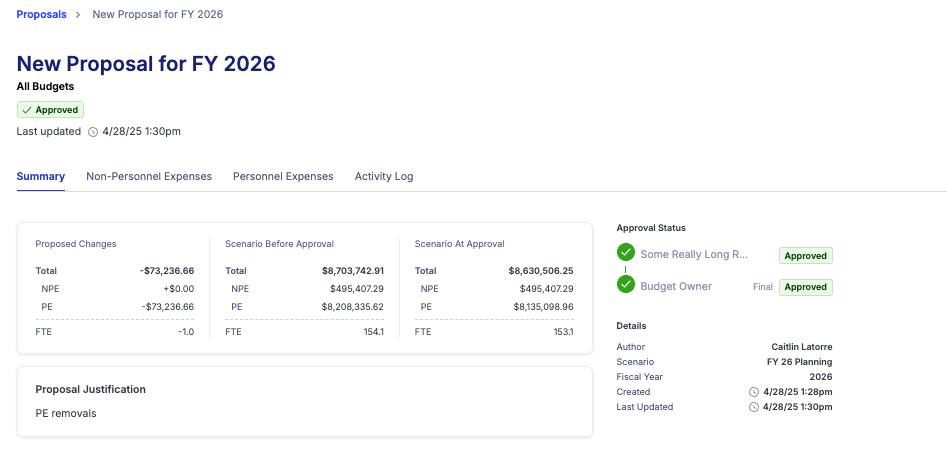
The top section of the Summary tab shows the following info:
-
Overview Section
-
Displays Budget name (or All Budgets) and shows the relevant fiscal year for your proposal.
-
-
Proposal Justification
-
Displays the explanation or reasoning behind the proposal. If no justification is provided, you’ll see a note stating that.
-
-
Approval Status
-
Shows the progress of your proposal through the approval steps, using a visual progress bar with labels for each step.
-
Summary of Changes Table
Beneath the top level section is the Summary of Changes table. The Summary of Changes table is designed to help you quickly see how your proposed budget differs from previous or current budgets. It pulls together all the key accounts and budget segments, showing what’s being changed, how much, and where.
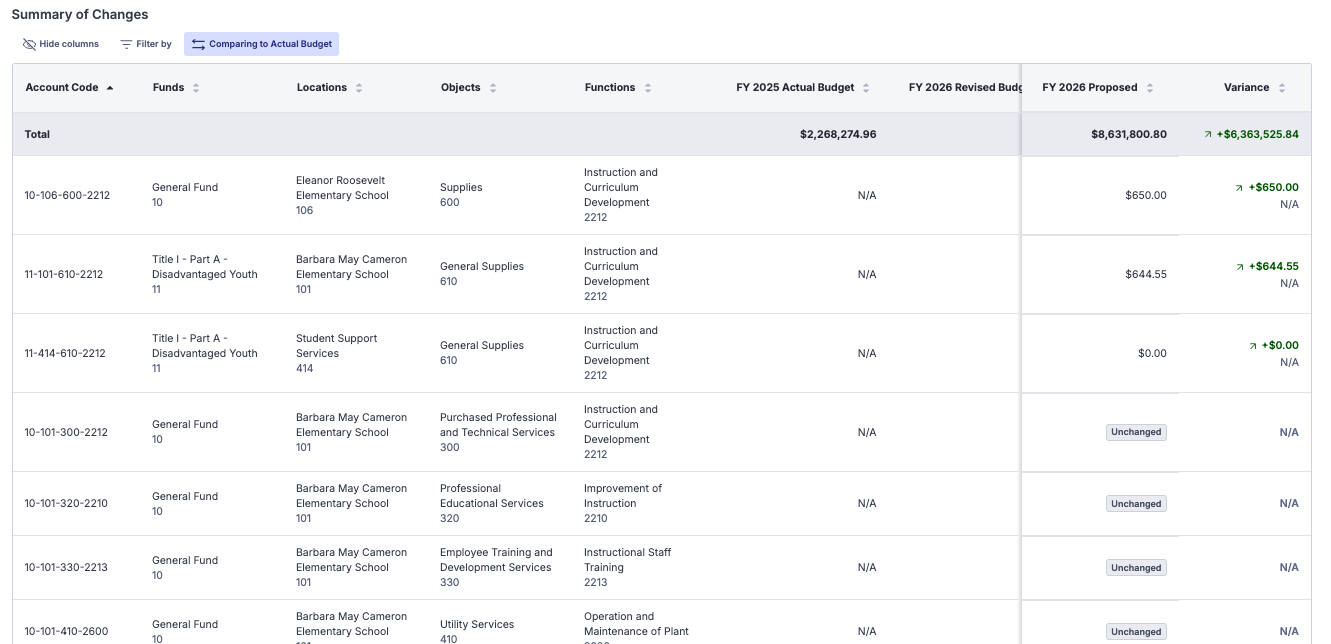
Each row in the table represents a specific account or item in your budget. You’ll see details like account codes and segment information (such as Fund or Function).
The columns break down the budget details for each account. They include:
-
Account Code: The identifier for each account.
-
Segments: Details like Fund, Function, or other categories your district uses.
-
Actual Budget: What was actually spent in the previous fiscal year.
-
Revised Budget: Updated budget for the current year.
-
Currently Approved: The amount currently approved for this account.
-
Proposed: The new amount you’re proposing.
-
Variance: The difference between your proposal and the budget you’re comparing against (shown as a number and with colored arrows for increases or decreases).
You can hide columns, filter by segments, or apply other filters to focus on what matters most to you. Table results are also exportable.
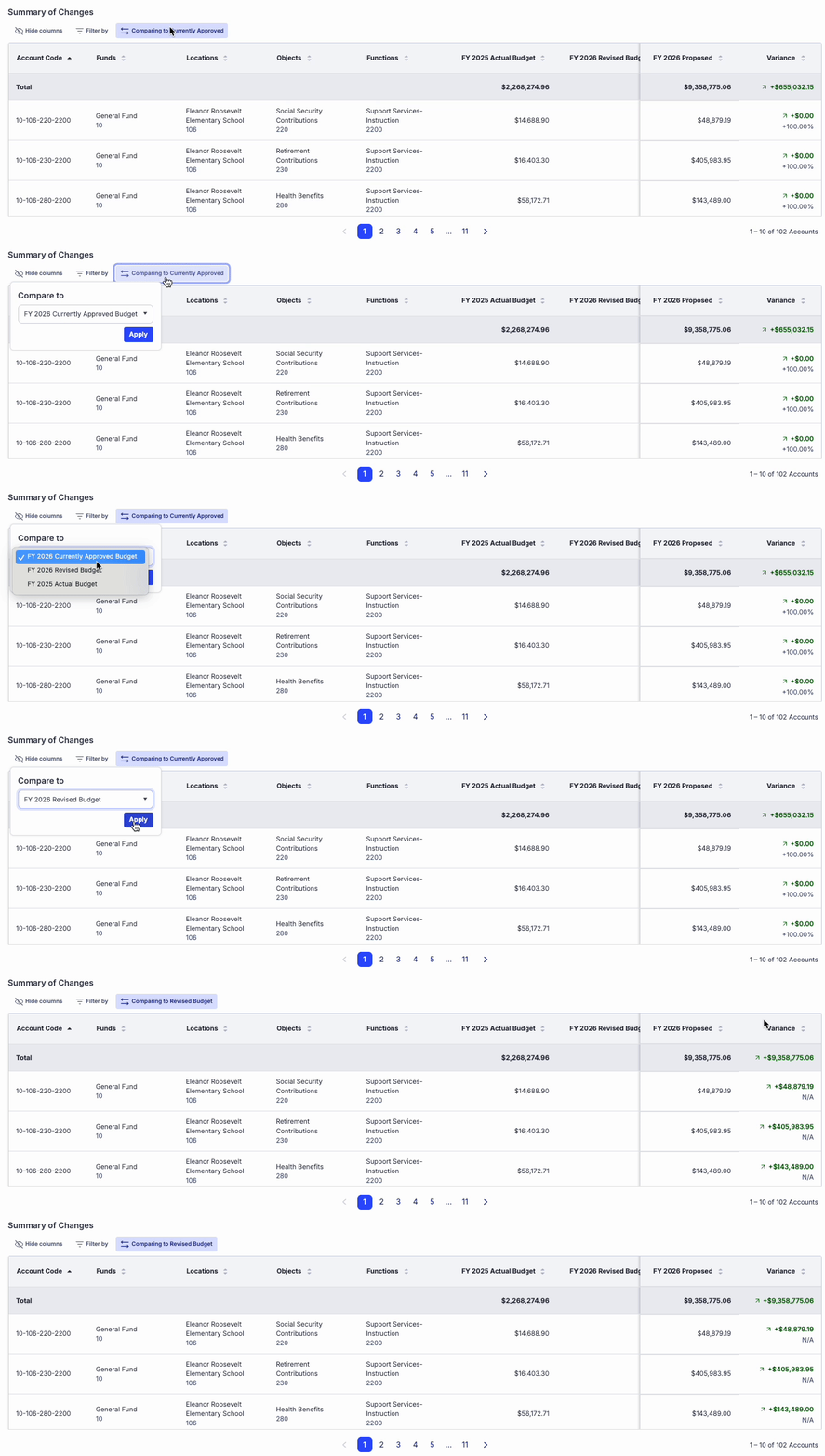
We’ve added a ‘Compare To’ button for this table as well. Here, users can choose which budget version to compare the proposal updates against (Actual, Revised, Currently Approved). The variance column updates to show the difference between the proposal and the selected comparison.